You’re juggling a dozen projects at home or work, your phone is buzzing with texts, and today is the day everyone calls you for a “quick chat.” In the middle of all that, you’re racking your brain trying to remember when your next appointment is.
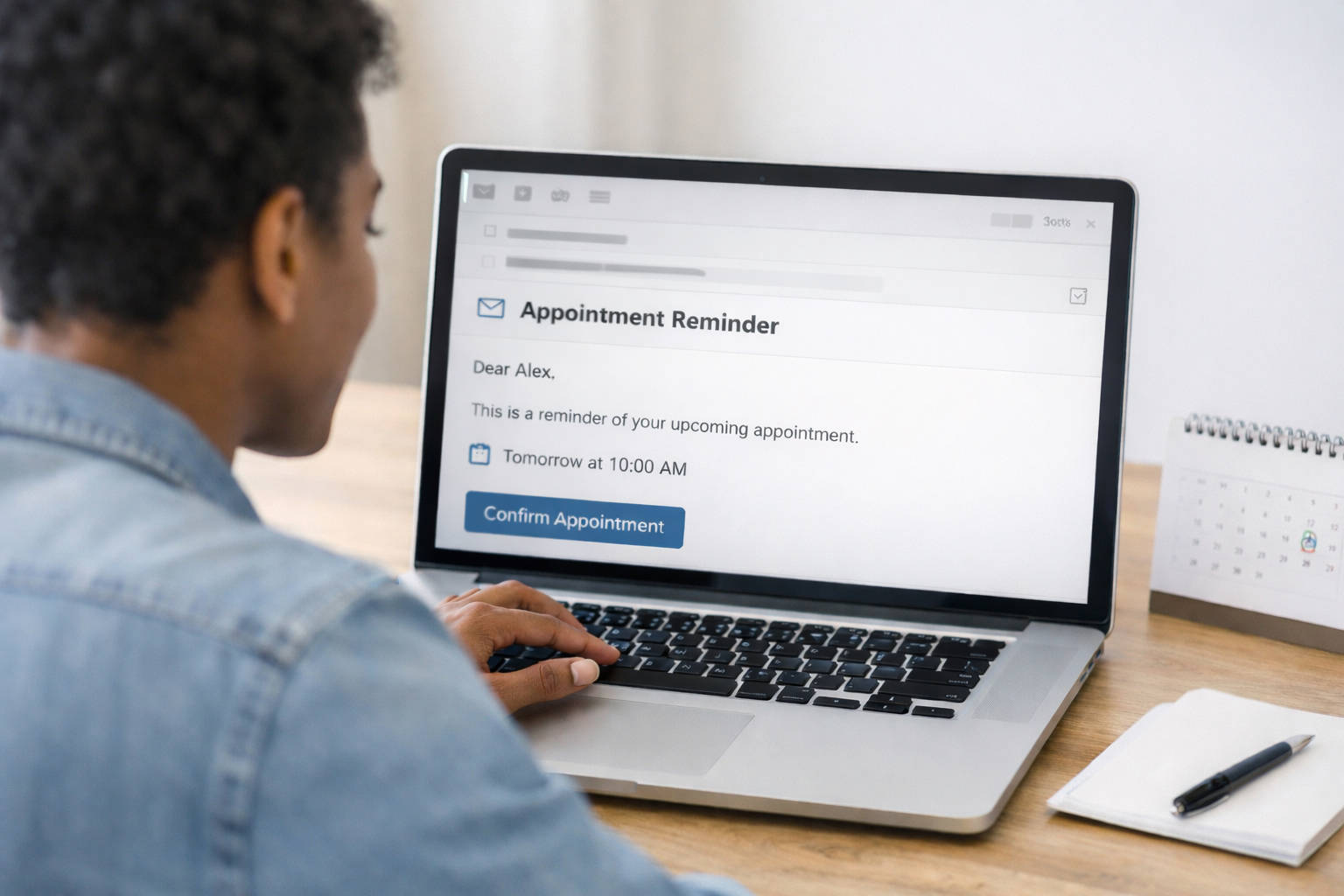
Now, imagine you spot an email appointment reminder in your inbox. It neatly holds all the details for your upcoming visit and lets you add the appointment to your calendar. You can even confirm, cancel, or reschedule your appointment with a single click. It’s a small thing that makes life a whole lot easier.
For appointment-based businesses, email reminders remain one of the most reliable ways to reduce no-shows, protect revenue, and keep schedules on time. When paired with text and phone reminders, they do what those channels cannot by including more robust appointment details, attachments, links, forms, etc.
This guide shows you how to write and automate appointment reminder emails that people actually read, click, and respond to, so fewer spots on your calendar go empty.
What is an appointment reminder email?
An appointment reminder email is an email message a business sends to a client to notify them about an upcoming appointment. It typically includes the appointment’s date, time, location, or a virtual meeting link with instructions on how to join. Often, the appointment reminder email will give the client a clear next step, such as confirming, rescheduling, or canceling.
Email appointment reminders are not limited by length and can be formatted with plain text or HTML, making it easy to include lots of detail and structure. They also create a searchable record that clients can come back to when they need to find their appointment information again.
When email is the best channel (and when it’s not)
Email is best when you need to include:
- Prep instructions (forms, what to bring, arrive early)
- Multiple attachments or links
- Large attachments (file-size)
- Detailed location info or multi-location details
- A clear audit trail for policies and disputes
Email is not the best channel when:
- You need a fast response (same-day, last-minute changes)
- Your clients rarely check email
- The message should be ultra-short
In those cases, SMS is usually the better “last mile” nudge. Calls are best for high-touch or complex situations.
The real reason email reminders still work
Email is still one of the most effective channels for appointment reminders because it is built for details. Email gives you the most room to share everything a client needs to show up prepared and on time.
That includes:
- Prep instructions, policies, and what to bring
- Links and attachments like forms, directions, invoices, and intake docs
- “Add to Calendar” buttons and reschedule links
- Searchable records that clients can find later when they forget details
On top of that, personalized email reminders make clients feel cared for. They show that their time matters, which builds trust and keeps people coming back. Emails also create a clear communication trail, making it easier to enforce policies and resolve disputes when something goes wrong.
And because email is inexpensive and easy to automate, it lets you do all of this at scale, helping you protect revenue and keep your schedule running smoothly without adding more work for your team.
Must-have elements in your email appointment reminders
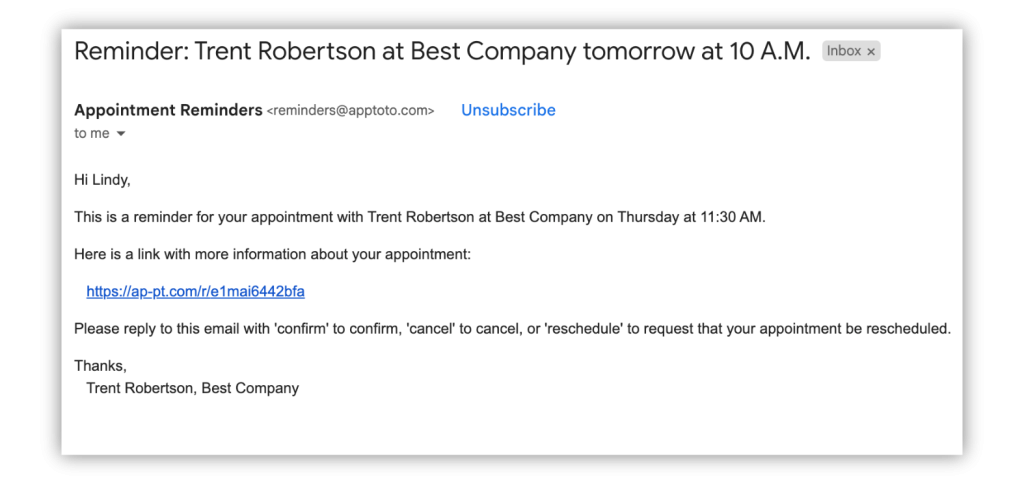
An effective email reminder is clear, skimmable, and action-oriented.
Key fields to include (checklist)
- Subject line (clear, not clever)
- Client name
- Appointment Details: Clearly state the appointment’s date and time
- Time Zone (if virtual)
- Location address OR meeting link
- Service type (what the appointment is for)*
- Clear Call to Action: Make it easy for clients to confirm, reschedule, or cancel easily with CTA buttons or an appointment page link.
- Contact method for questions (phone or email)
- Unsubscribe button
Keep in mind that the details above are just the bare minimum to include.
Optional fields that help reduce no-shows
Layering in more advanced details about your clients and their appointments from your various business tools can help personalize your appointment reminders even further.
- Prep instructions (forms, what to bring, arrival time, etc.)
- Parking/location notes (if needed to help prevent late arrivals)
- Policy reminders (late cancel or no-show policy acknowledgement)
- Add to calendar link
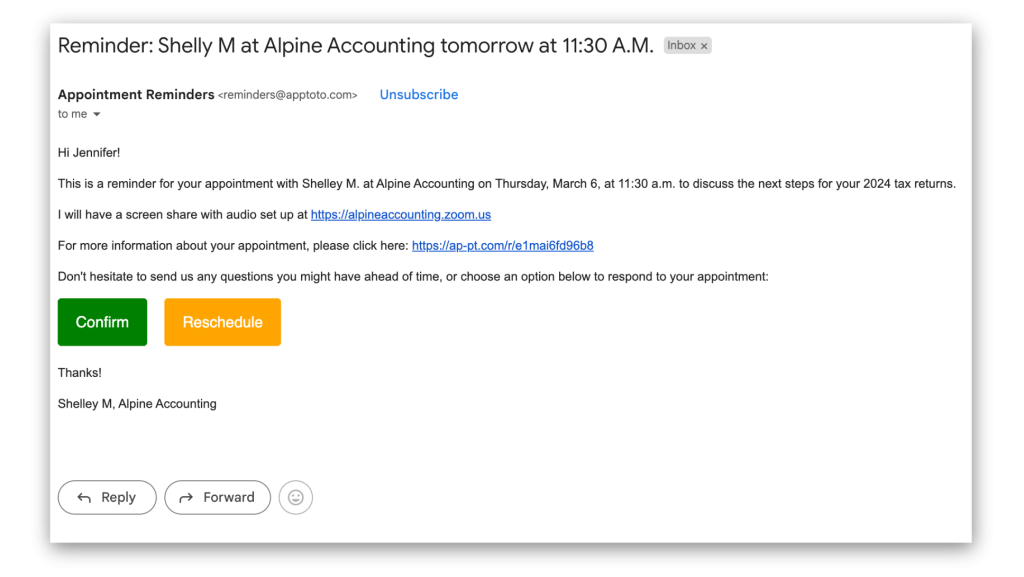
Tone and Style
Your reminder emails should sound like your business. Different industries call for different communication styles. For example, an accountant might opt for a more formal tone, while a salon can be more relaxed and playful. The goal is consistency. Don’t be afraid to experiment to find the perfect mix of brand personality, visual style, and tone for your emails!
When to send appointment reminder emails
Timing matters as much as your wording. A good cadence gives clients time to prepare, reschedule if needed, or ask questions before it’s too late.
| Cadence | Use it when | Send email #1 | Send email #2 | Optional add-on |
|---|---|---|---|---|
| Standard | Clients usually book appointments with a 1-14-day lead time | Client is a chronic no-show, or the appointment is high-value | 48-72 hrs before | SMS 2-4 hrs before |
| Long-lead time | Booked 2+ weeks out | Immeadiately | 7 days before | 24 hrs + SMS 2 hrs before |
| Likely no-show OR high-value client | Client is a chronic no-show or the appointment is high-value | Immeadiately | 72 hrs + 24 hrs before | SMS 2 hrs before |
Tie each cadence to a goal:
- Standard = Remind clients early enough that they can still reschedule, then reinforce the appointment time on the day of
- Long-lead time = Prevent “I forgot I booked this” excuses. Remind the day prior and the day of (optionally).
- High-no-show/high-value = Reduce revenue risk and protect staff time. Include notice of cancellation policy in 72 hr email (at minimum).
Best time of day to send email reminders
Wondering specifically what the best time of day to send reminders is? Our comprehensive guide to appointment reminders revealed that the highest response rates came from emails sent at 5 a.m., then 10 a.m followed by 9 a.m.
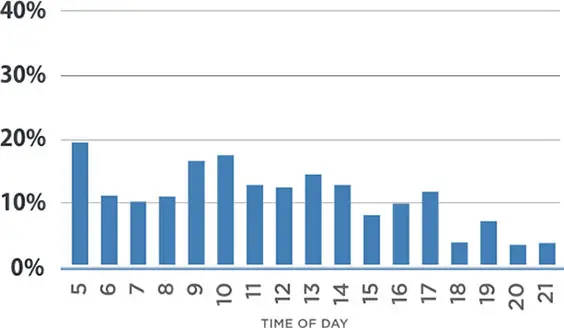
Use these times as a starting baseline, then test by:
- Client type (e.g., if you serve working professionals vs. retirees)
- Appointment types
- Time zones (especially for virtual versus in-person)
Appointment reminder email templates
Below are templates organized by timing and scenario. Feel free to swap in your field and links, and sprinkle in your brand personality. Then, reuse as needed!
Booking Confirmation (send immediately)
Subject: Confirmed: [Service] on [Date] at [Time]
Hi [First Name],
Thank you for booking an appointment with [Provider Name] at [Company]. Your appointment is on [Date] at [Time] [Time Zone (if virtual)].
Please arrive at [Address] OR Join: [Meeting Link].
Here is a link with more information about your appointment: [Booking Link]
Please reply to this email with [Confirmation Instructions].
We look forward to serving you soon!
Thanks,
[Provider Name] at [Company Name]
Reminder (7 days before)
Subject: Upcoming appointment next week: [Date] at [Time]
Hi [First Name],
This is a quick reminder that your upcoming [Service] is next week.
[Date] at [Time] with [Provider Name].
Please click “Confirm” below to let us know you’ll be attending, or reschedule or cancel your appointment here: [Booking Link]
[CONFIRM button]
If you have questions, you can also reply to this email or call [Phone], and we’ll respond as soon as we’re able!
Thanks,
[Provider Name] at [Company Name]
Reminder (48 hrs before, cancellation reminder)
Subject: Reminder: [Service] in 2 days ([Date] at [Time])
Hi [First Name], this is a reminder that your [Service] with [Provider Name] is this [Day of Week] at [Time].
Please reply “Confirm” to this email to let us know you’ll be attending, or reschedule or cancel here: [Booking Link].
As a reminder, you must cancel within [Cancellation window] to avoid [Cancellation penalties]. [Cancellation Policy Link]
We look forward to seeing you soon!
– [Company Name]
Reminder (24 hrs before, cancellation window passed)
Subject: Reminder: [Service] tomorrow at [Time]
Hi [First Name], your appointment at [Company Name] is tomorrow.
[Service]
[Time] with [Provider Name]
Reminder (same-day reminder)
Subject: Appointment Today: [Service] at [Time]
Hi [First Name], your appointment with [Provider Name] is today at [Time].
We’re located at [Address]. [Parking Instructions(if needed)].
Online changes to your appointment are no longer possible. If there’s an emergency, please contact [Provider Name] at [Phone].
Telehealth / Virtual (with meeting link)
Subject: Upcoming virtual appointment: [Date] at [Time]
Hi [First Name],
Here are the details for your virtual appointment with [Provider Name] at [Company Name].
When: [Date] at [Time] [Time Zone]
Join Link: [Virtual Meeting Link]
Tip: Please join 2-3 minutes early to ensure your audio and video are working as expected!
[CONFIRM button]
If you’re unable to make it, please cancel or reschedule your meeting here [Appointment Link].
Thanks,
[Provider Name] at [Company Name]
New Client / First Appointment (Directions / Forms / Intake)
Subject: Your First Appointment at [Company Name]: [Date] at [Time]
Hi [First Name],
We’re looking forward to meeting you. To make your first visit easier, we wanted to provide some helpful information about your upcoming visit and share how to best prepare ahead of time:
When: [Date] at [Time]
Provider: [Provider Name]
Please Bring: [List] OR Forms to Complete Before Your Visit: [Link(s)]
Please Arrive: [X minutes] early
Location: [Address] [Parking directions (if needed)]
Please click “Confirm” below to let us know you’ll be attending, or reschedule or cancel your appointment here: [Booking Link]
[CONFIRM button]
If you have questions, you can also reply to this email or call [Phone], and we’ll respond as soon as we’re able!
Best,
[Company Name]
SMS vs Email vs Phone Reminders
So what are email’s unique strengths over SMS and phone reminders?
| CHANNEL | STRENGTH | WHEN TO USE |
|---|---|---|
| SMS Text | Fastest open/read; ideal for short, timely alerts | Short, simple reminders 24–48h and same‑day |
| Great for detailed info and attachments, easily searchable appointment details | Pre‑appointment prep forms or long instructions | |
| Phone Calls | Personalized and direct | Complex logistics or high‑touch clients |
Most effective workflows use a mix: SMS for quick reminders, email for detailed directions or forms, and optional calls for complex appointments.
How to keep reminder emails out of spam and in front of clients
Subject lines that get opened (not ignored)
Staightforward
- Reminder: [Service] on [Date] at [Time]
- Upcoming appointment: [Date] at [Time]
- Your appointment details for [Date]
- Appointment reminder from [Business]
- Scheduled: [Service] with [Provider] on [Date]
Confirmation-required
- Please confirm your appointment for [Date]
- Confirm: [Service] tomorrow at [Time]
- Quick confirmation needed: [Date] at [Time]
- Are you still able to make it on [Date]?
- Confirm or reschedule: [Date] at [Time]
Friendly and warm
- Looking forward to seeing you on [Date]
- We’ll see you soon: [Date] at [Time]
- Your appointment is coming up, [First Name]
- See you tomorrow, [First Name]
- We can’t wait for your visit on [Date], [First Name]!
Action-required (forms, prep)
- Action required before your appointment on [Date]
- Please complete this before your visit
- Reminder: forms needed for your appointment
- Prep needed for your appointment on [Date]
- One quick step before your appointment
Virtual appointment link-included
- Virtual appointment link for [Date] at [Time]
- Meeting link: your appointment on [Date]
- Your virtual call details: [Date] at [Time]
- Meeting link enclosed: [Date] at [Time]
- [First Name], Your virtual appointment instructions are inside
Email deliverability and formatting (that actually matter)
This is where many “good” reminder emails quietly fail.
- Use a human “From” name (your business name, not a software label)
- Use a monitored reply-to address. Avoid no-reply whenever possible
- Buttons beat tiny links on mobile
- Always include the time zone for virtual appointments
- Put the appointment details above the fold (or “scroll”)
- Provide an “unsubscribe” option (yes, even on appointment reminders)
- If using a third-party reminder software, make sure to authenticate your sending domain (SPF + DKIM) if you send from your business email to avoid ending up in SPAM
Policies and compliance (that protect you and your clients)
Policies reduce disputes and protect your schedule, but tone matters.
Late cancel / no-show policy snippet templates
- Neutral: “If you need to change your time, please reschedule at least 24 hours in advance.”
- Fee version: “Cancellations within 24 hours may be subject to a fee of $X.”
- Friendly-but-firm: “We hold this time just for you. If plans change, reschedule here so we can offer the slot to someone else.”
For guidance on adding cancellation policies to reminders or creating a full policy, see our appointment cancellation policy guide.
Prep instructions
If clients need to do something before the appointment, keep it simple:
- What to do
- By when
- Link
- Who to contact if stuck
HIPAA-safe wording note
If you’re in healthcare, avoid including any protected health information (PHI) in the subject line or body of your email to avoid violating HIPAA compliance. At the same time, limit the use of personally identifiable information (PII), such as the patient’s name, email address, and address, whenever possible. Use general language (for example, “appointment reminder”) and share specifics only if your compliance rules allow it.
Automation: How to send email appointment reminders without creating more work
Manually emailing every client about their appointment does not scale. Customizing details, tracking replies, and juggling confirmations, cancellations, and reschedules quickly turns into a full-time job.
That’s why most appointment-based businesses automate email reminders. The right system ensures messages go out on time, include the right details, and handle responses automatically, without adding work for your team.
What to look for in an automated email reminder system
A reliable reminder setup should cover four core areas.
1) Automation and timing
Your reminder system should automatically send emails based on the appointments already on your calendar.
Look for tools that support:
- Booking confirmations, reminders, and follow-ups
- Flexible timing (for example, 7 days, 48 hours, and 24 hours before)
- Multi-channel sequences (email first, SMS later if needed)
This ensures reminders stay accurate even when appointments are added, changed, or canceled.
2) Customization and personalization
One-size-fits-all reminders no longer work. A flexible system should let you:
- Create different messages by appointment type, service, provider, or location
- Customize messages by step (confirmation vs reminder vs follow-up)
- Automatically personalize emails with client names, dates, times, services, and locations
This keeps reminders relevant without requiring manual edits.
3) Integrations with your existing tools
Your reminder emails are only as accurate as the data behind them.
At a minimum, your appointment reminder and scheduling system should integrate with:
- Calendars (such as Google Calendar or Outlook) so reminders reflect real-time changes
- CRMs (like Salesforce) to pull in client details and track communications
- Virtual meeting tools (Zoom, Microsoft Teams, Google Meet) to include meeting links automatically
- Payment processors (Stripe, Square) if you collect payments during booking or via reminders
These integrations prevent mismatches between what clients see and what’s actually scheduled.
4) Two-way interactions
The biggest time-saver is letting clients manage their own changes.
Email reminders should include:
- Confirmation links or buttons
- Reschedule links that show real-time availability
- Cancellation options when appropriate
- A monitored inbox/reply-to address so clients can ask questions
This reduces phone calls, inbox clutter, and last-minute surprises.
5) Reporting and analytics
Automation is only useful if you can measure what’s working.
Your reminder system should track:
- Email open and click rates
- Confirmations and reschedules
- No-show trends over time
These insights help you adjust timing, subject lines, and cadence to further reduce missed appointments.
How to Set Up Appointment Reminder Texts in Apptoto
Time needed: 15 minutes
Apptoto sends appointment reminder emails automatically based on the appointments already on your calendar.
Once you connect your appointment calendar to Apptoto, you set up your message timing and templates and add your clients’ contact information. Apptoto automatically pulls in your client names, dates, times, and services into messages. You can send a single email reminder or run a full booking confirmation, appointment reminder, and follow-up sequence.
Here’s how to start sending appointment reminder emails. We’ve covered SMS text appointment reminders in a previous post, and will cover calls next.
- Log in to Apptoto
Log in to Apptoto or sign up for a free 14-day trial if you’ve never used Apptoto before!
- Add a new calendar
If you’re logging in for the first time, you’ll be prompted to connect a calendar during the onboarding process. Otherwise, navigate to “Settings” > “Calendars.” Choose your calendar from the list, or click “Create Calendar” to add an “Apptoto Calendar.”

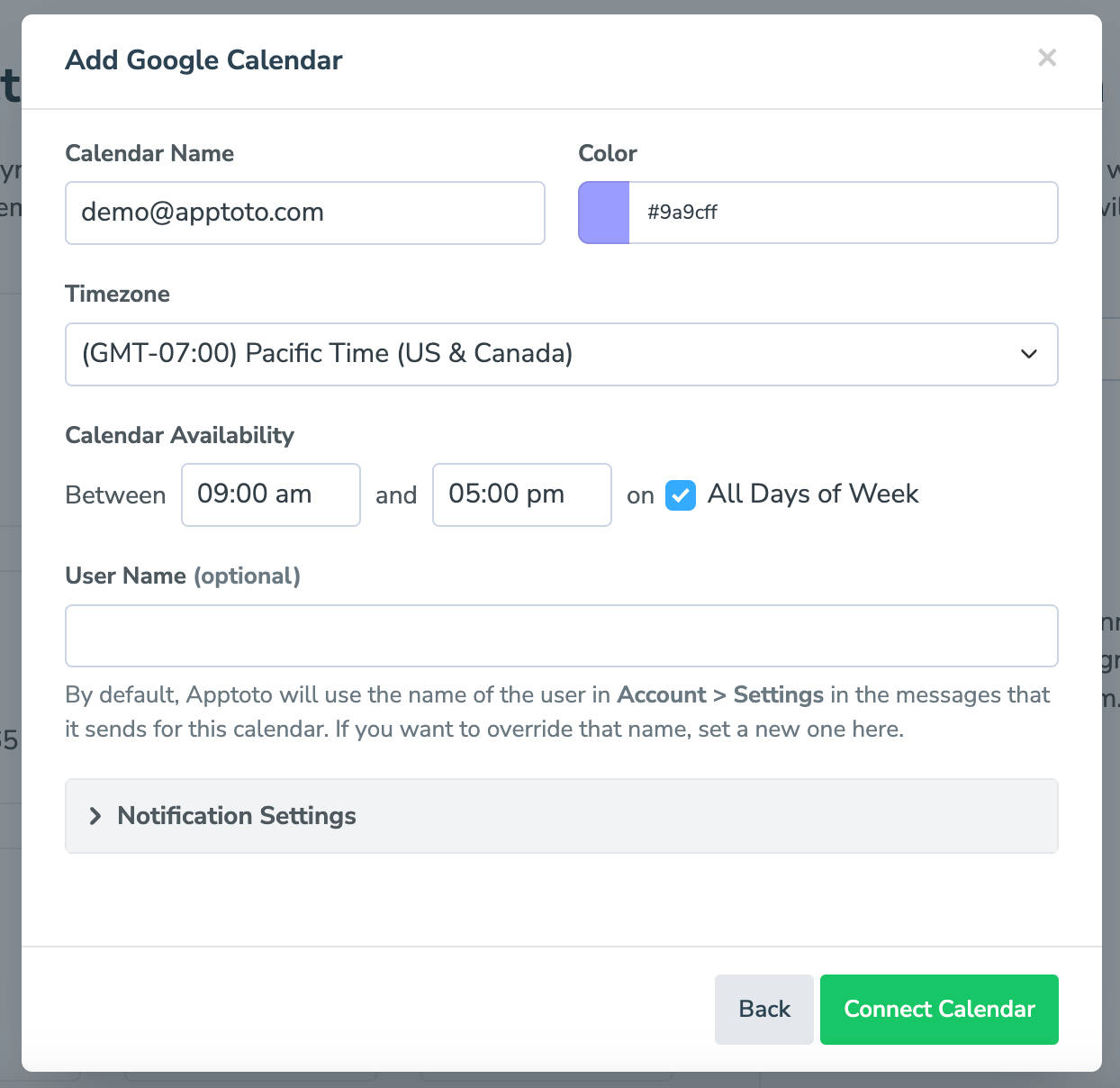
- Adjust your calendar settings
Set the calendar name, your availability, and desired notifications settings. Then, click “Connect Calendar.”
- Appointments will automatically sync to Apptoto
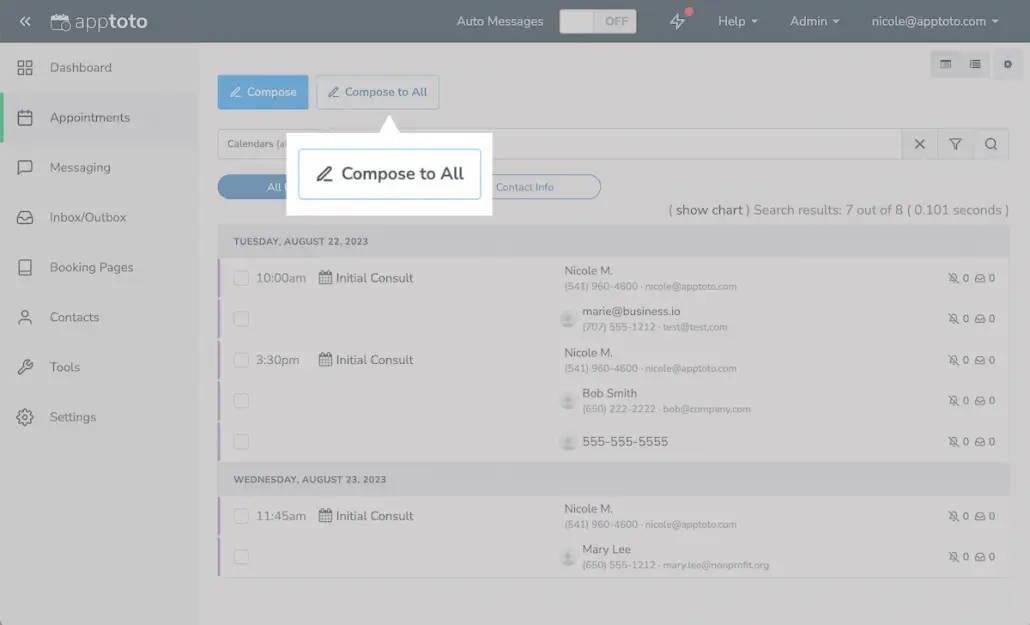
On the “Appointments” tab, you’ll now see a list of upcoming appointments.

- Add an address book
Navigate back to “Settings” > “Address Books” tab. Click “+Add” and follow the prompts to add your preferred contact address book(s).

- Set up automated appointment reminder emails
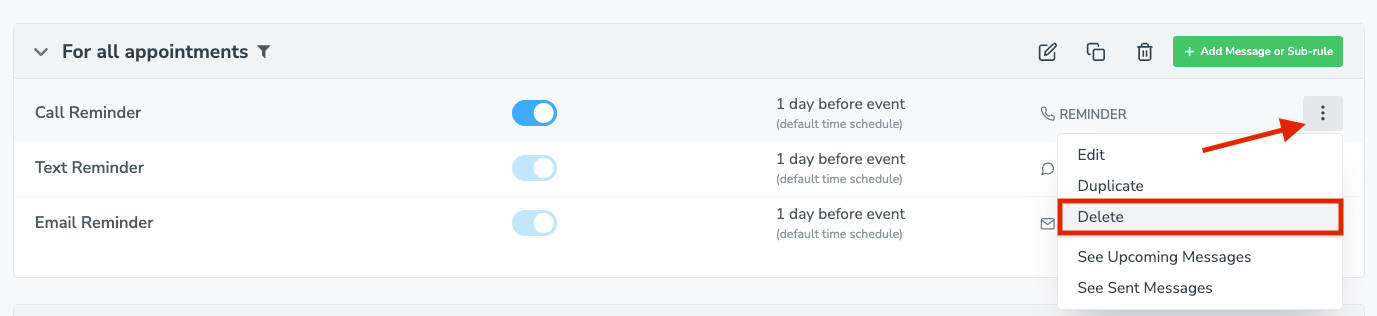
Navigate to the “Message” > “Appointment Auto Messages” tab. Three reminder messages (a call reminder, a text reminder, and an email reminder) will be created by default.
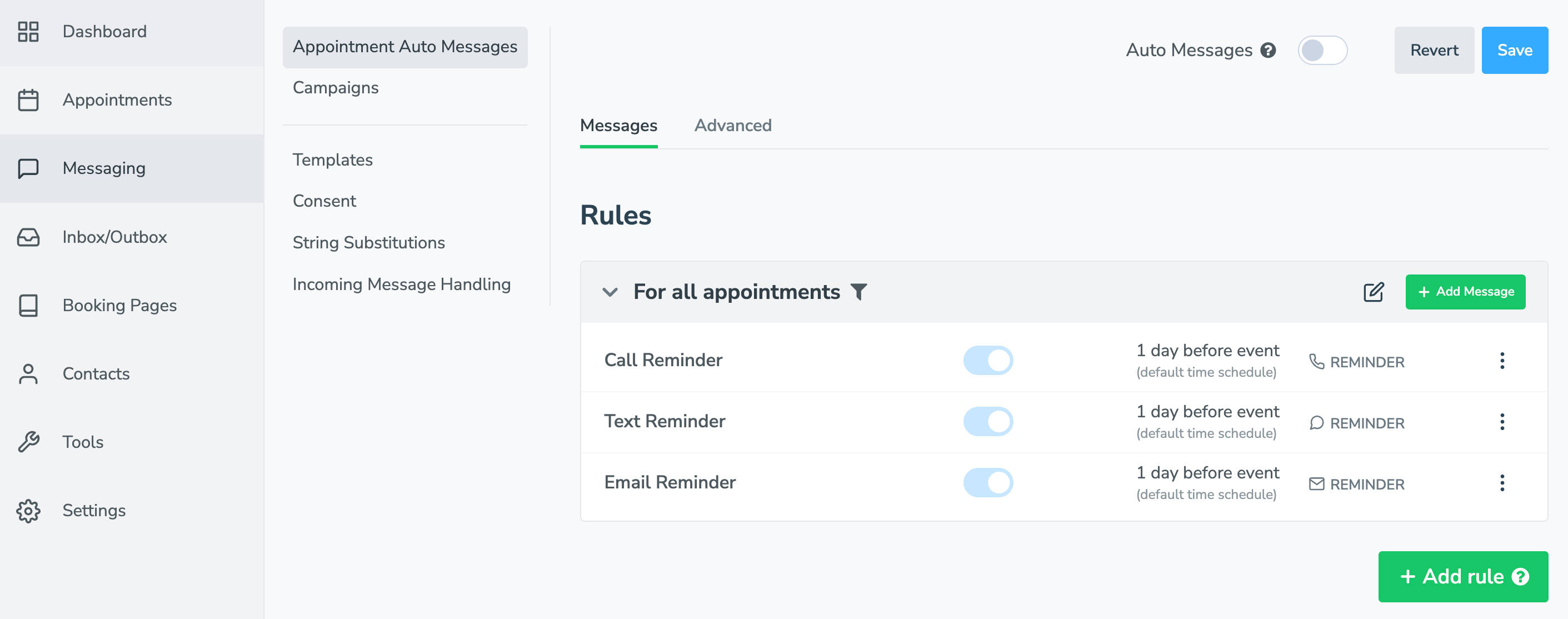
- Edit default reminder messages
If you only want to run email appointment reminders, click the three-dot menu to the right of call and text reminders. Then click delete.
- Create new email reminders
Click “+Add Message” then “Email.” Set the email’s purpose (booking confirmation, reminder, or follow-up), timing, language, message content (including subject), and auto-replies.
NOTE: The email body will automatically include {{reminder.link}} or {{booking.link}} which will take the client to a appointment page with details about their upcoming appointment and {{reminder.prompt}} or {{booking prompt }} with CTAs to confirm, cancel, or reschedule (although these can be removed and edited).
Click “Done & Save.”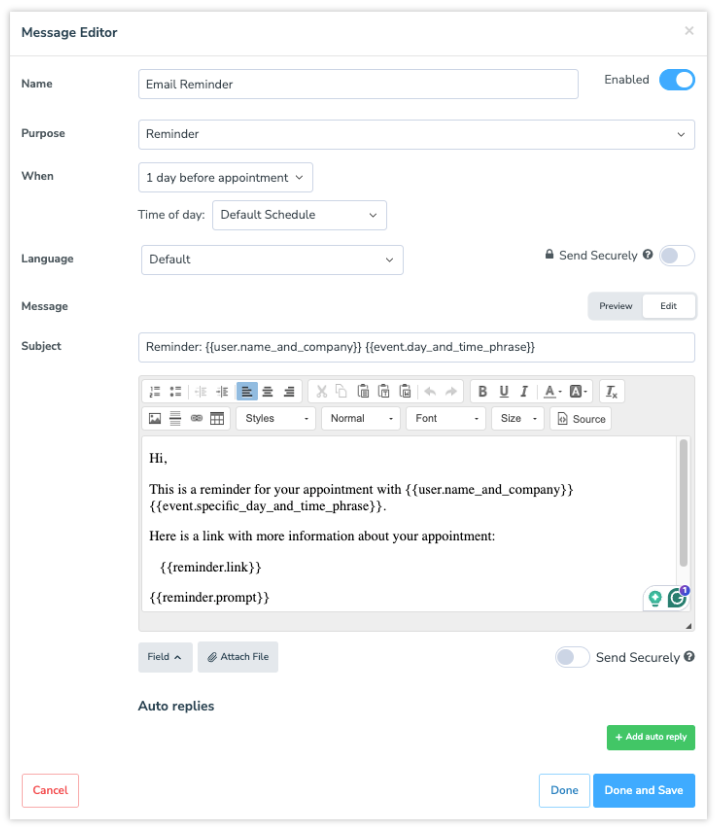
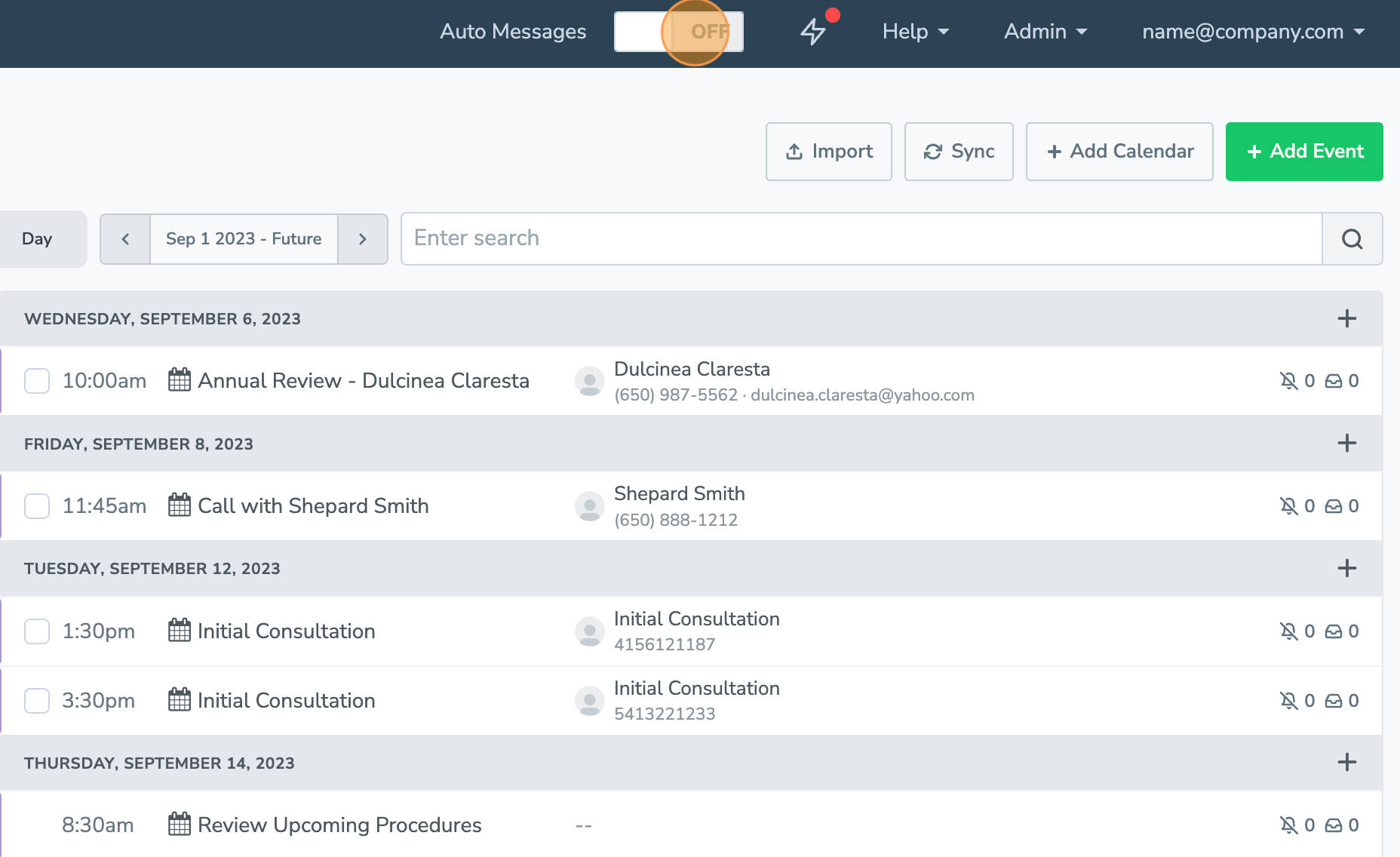
- Enable auto-messages to deliver reminders automatically
Create as many reminder sequences as you need. To launch, turn the “Auto Messages” button at the top of the screen to “On.”
Optional: Set up rules to send specific messages to certain appointments based on their event details (e.g., name or start time), participant details (e.g., confirmation status), calendar, or payment details.
Appointment Reminder Email FAQ
At a minimum, an appointment reminder email should include a clear subject line, the client’s name, the appointment date/time, the meeting location or meeting link, the service type, and a clear confirm/reschedule option.
Yes. Booking confirmations help reduce disputes with clients, give them a searchable record of their appointment date and time, and set expectations immediately. If you can, give them the option to add the appointment event to their calendar immediately as a safeguard.
Appointment reminders are not marketing emails. Subject lines should be clear and specific, and include the date and time when possible. If you need the client to take an action immediately, you can call that out as well (i.e., “Confirm Your Upcoming Appointment.”
No! Avoid no-reply email addresses. If clients need help, give them a path to reach you. If clients reply to email appointment reminders via Apptoto, their responses are immediately sent to your Inbox for you to address using two-way business messaging.
Keep emails to a single column. Use short blocks and a single primary CTA button, if possible. Keep key details above the fold as well.
Keep your reminders general and never include any protected health information (PHI), such as the patient’s full name, diagnosis, healthcare clinic names (if disclosing them could reveal the recipient’s health status), or medications. Use HIPAA-compliant appointment reminder software, and be sure to follow your company’s compliance guidelines and approval requirements before sending any patient messages.
Automate Email Appointment Reminders Today
No-shows and messy schedules don’t have to be part of the job. Try email appointment reminders free for 14 days and see how much easier it is to keep your calendar full and your clients on track. Start with a few simple reminders and feel the difference fast. Your schedule (and your clients) will thank you.
Read more of our 3-part appointment reminder series
- Part 1: Appointment Reminder Texts (templates, timing, and an SMS generator)
- Part 2: Appointment Reminder Emails (you’re here)
- Part 3: Appointment Reminder Calls
For the most reliable results, use a mixed approach: email for details and links, SMS for last-mile nudges, and calls for high-touch or complex situations.