

Your 2:00 PM comprehensive exam just no-showed. That’s a 30-minute slot, gone. The pre-test tech prepped the room, your front desk verified insurance, and now everyone’s standing around waiting for a patient who isn’t coming.
For a practice seeing 20 to 25 patients a day, two or three no-shows per week cost thousands per month in lost revenue and wasted chair time. The average healthcare no-show rate sits between 15% and 30%, and optometry faces unique pressures that push that number higher.
Most no-shows are preventable. Practices using automated reminders, easy online scheduling, and proactive patient recall have cut their no-show rates by up to 90%. Here’s how to do the same in yours.
Why optometry practices lose more patients to no-shows than they think
No-shows aren’t a scheduling inconvenience. They’re a revenue drain that hits optometry harder than most specialties.
The cost of patient no-shows (beyond the empty chair)
When a patient no-shows, you don’t just lose the exam fee. You lose the optical sale (frames, lenses, coatings), contact lens fitting revenue, and any follow-up visits that appointment would have generated. A single comprehensive exam with an optical purchase often totals $300 to $500.
Your technician already prepped the room and pulled records. Your front desk spent time verifying insurance. That labor doesn’t disappear because the patient didn’t show. A few no-shows per week add up to $2,000 to $5,00 in lost revenue and wasted staff time per month.
Without automated reminders, your practice is likely losing 15% to 30% of its scheduled appointments each week. At $300 to $500 per visit, that gap widens fast.
Calculate Your No-Show Cost
See how much missed appointments are costing your practice every year.
Why optometry no-shows happen
When researchers studied why patients skip appointments, the top reason was simple: 36% just forgot. In optometry, this is worse than in most fields. When a patient’s next visit is 12 months away, forgetting is almost guaranteed.
A toothache drives someone back to the dentist. Chest pain sends them to the cardiologist. But a gradual change in vision? No urgency. Patients know they should come in. They just don’t feel the push.
Insurance timing compounds the problem. VSP and EyeMed benefits reset at the start of the year, leading to a surge in bookings in January and February. Patients schedule their annual exam months in advance, then forget by the time it arrives. Because optometry depends heavily on that annual exam cycle, every missed peak-season appointment hits harder.
Picture this: In January, your front desk books Mrs. Chen for her annual comprehensive in March. Her VSP benefits just renewed, and she wants new progressive lenses. By March, she’s forgotten. No reminder, no show. Your tech prepped the autorefractor, your front desk verified VSP eligibility, and $400 in revenue (exam plus progressives) just evaporated. She didn’t cancel. She didn’t call. She simply forgot.
The Top Reasons Your Chair
Sits Empty
Based on 100 surveyed patients who missed appointments
45% of no-shows are caused by forgetting or never being notified. Both are solved by automated appointment reminders.

Automated appointment reminders that actually reach your optometry patients
If forgetting causes 36% of no-shows, the fix is simple: don’t let patients forget. The single highest-impact change you can make is to send automated appointment reminders across multiple channels, timed so patients confirm or reschedule before the slot goes to waste.
Text, email, and voice: why you need all three
Not every patient reads texts. Not every patient checks voicemail. A multi-channel approach covers both: 90% of text messages are read within three seconds, and text reminders drive a 53.5% higher response rate than voice calls alone. But for older patients who prefer a phone call, voice still matters.
Don’t pick one channel. Reach each patient through the channel they actually respond to. Text, email, and voice reminders together mean no patient slips through the cracks.
This approach isn’t theoretical. Over 3,000 businesses have used Apptoto to manage appointment communication since 2010, and the average client stays for seven years. That kind of retention only happens when the system works.
Need inspiration for your messages? Browse these 87 appointment reminder templates and customize them for your practice.
What an optometry reminder sequence looks like
Here’s a proven three-touch sequence built for optometry:
- One week out: Email with date, time, provider name, and what to bring (insurance card, current eyewear). Gives patients time to reschedule if they have a conflict.
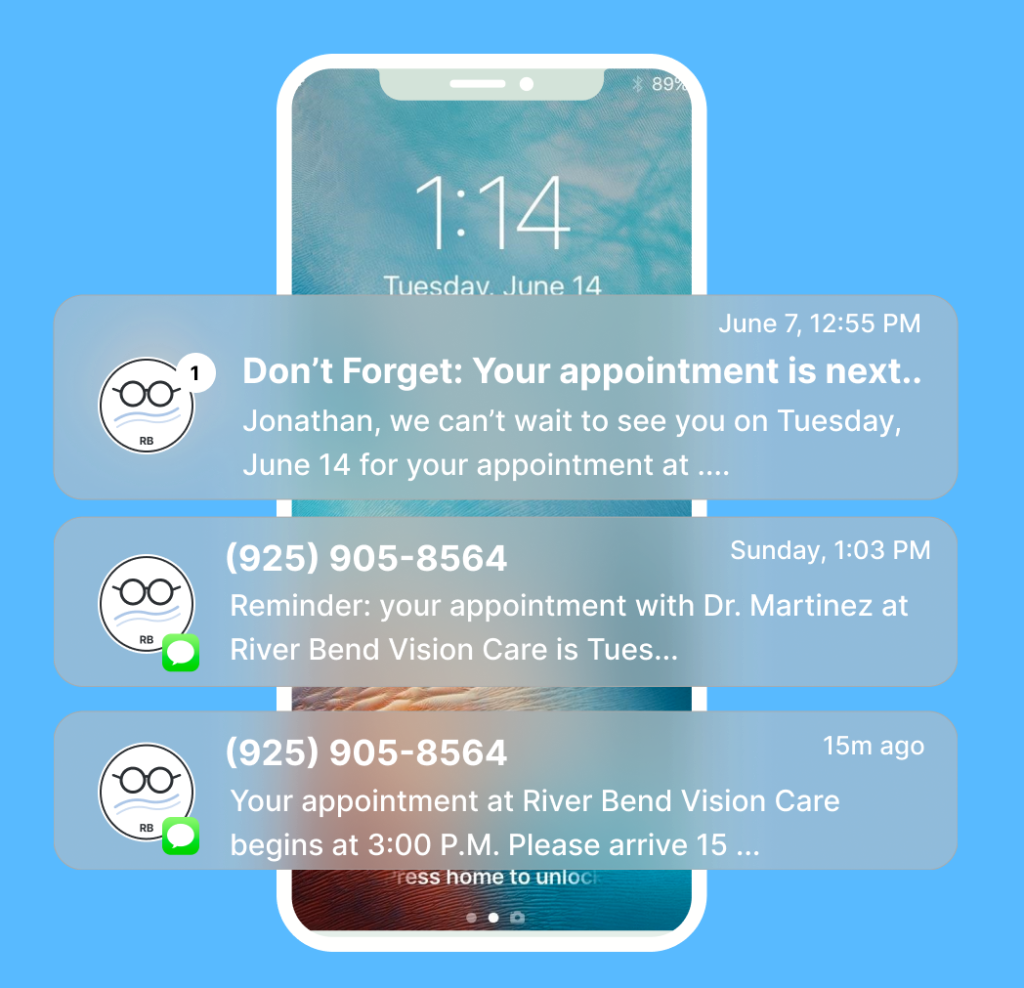
- Two days out: Text with a simple confirm, cancel, or reschedule option. Keep it short: “Hello, your appointment at {{Optician’s Office}} is on Thursday at 2:00 PM. Reply 1 to confirm, 2 to cancel, or 3 to reschedule.”
- Morning of: Text with office address, parking info, and a reminder to arrive 10 minutes early. Catches patients who are confirmed but might still forget
Different appointment types need different reminders. A comprehensive exam: “Bring your insurance card and current eyewear.” A frame pickup: just the time window and location. One-size-fits-all doesn’t cut it.
Ready-to-use optometry reminder templates:
Comprehensive Exam
Hi {{First Name}}, this is a reminder you have an appointment with Dr. {{Provider}} is on {{Date}} at {{Time}}. Please bring your insurance card. Reply 1 to confirm, 2 to cancel, or 3 to reschedule. {{Confirmation URL}}
Follow-Up Visit:
Hi {{First Name}}, your follow-up visit with Dr. {{Provider}} is on {{Date}} at {{Time}}. Reply 1 to confirm, 2 to cancel, or 3 to reschedule. {{Confirmation URL}}
Frame/Glasses Pickup:
Hi {{First Name}}, your order is ready for pickup at {{Practice Name}}. Please bring a valid photo ID. Call us at {{Phone}} with any questions.
Annual Exam Recall (*Send Securely)
Hi {{First Name}}, it’s been about a year since your last eye exam with Dr. {{Provider}}. Your {{VSP/EyeMed}} benefits have renewed. Book your annual exam before the schedule fills up: {{Booking URL}}
*A note on HIPAA compliance: These templates are starting points, not legal advice. While including patient or provider names is typically allowed in appointment reminders, directly including the appointment type, mentioning eyewear or eye conditions, or mentioning insurance details may qualify as protected health information (PHI). Before sending any patient-facing messages, review them with your compliance officer to confirm they meet HIPAA requirements for your practice.
For messages that include PHI, such as recall outreach referencing a patient’s insurance plan or last visit date, consider using a HIPAA-compliant messaging platform with a secure messaging option. Apptoto’s Secure Messaging feature (currently in beta) sends patients a link to view their messages through an encrypted portal, rather than displaying private details in standard text or email. This keeps your communication HIPAA-compliant without sacrificing the convenience of automated outreach.
Apptoto’s rule-based messaging automates all of this. Set up different sequences for each appointment type, and each patient gets the right message for their visit without any manual sorting.
Let patients confirm, cancel, or reschedule by text
One-way reminders are better than nothing at reminding patients to show up, but two-way messaging delivers the real payoff. When patients can reply 1 to confirm, 2 to cancel, or 3 to reschedule, you get outcomes that protect your revenue.
Confirmations tell you the slot is solid. Reschedules recover revenue that would have been lost to a no-show. And including a cancel option matters too. It might feel counterintuitive, but giving patients a simple way to cancel beats the alternative: a no-show with zero notice. A cancellation at least opens the slot for someone else. Plus, if responding feels like a hassle or patients feel trapped, they won’t reply at all. The goal is to make every response effortless. Either way, your front desk stops spending 20 minutes playing phone tag with patients who won’t pick up.
For ready-made reschedule messages, grab these appointment reschedule text message templates.
See what automated reminders look like for an optometry practice. Start your free trial →
Keep your exam schedule full with automated patient recall
Reminders prevent most no-shows. But some cancellations are unavoidable. The difference between a practice that absorbs the loss and one that recovers it lies in speed: how quickly can you fill the open slot?
Automate outreach for annual exams
Most optometry revenue depends on the annual exam cycle. If a patient’s last visit was 11 months ago and they haven’t rebooked, that’s not a no-show problem. It’s a costly patient churn problem.
Automated recall campaigns catch patients before they lapse. Below are some recall templates you can steal.
Benefits Just Renewed:
Hi {{First Name}}, your {{VSP/EyeMed}} vision benefits have renewed for the year. Schedule your next appointment with Dr. {{Provider}} before our peak-season calendar fills up. Book online: {{Booking URL}}
Overdue (13+ Months)
Hi {{First Name}}, it’s been over a year since your last appointment at {{Practice Name}}. Annual exams catch changes in your vision and eye health early. Book your visit: {{ Booking URL}}
Apptoto’s Campaigns feature sends targeted SMS and email messages to patient segments such as those “due for annual exam” or with “renewed vision benefits.” Your front desk stops manually calling through recall lists. Patients book themselves.
The tricky part with recall is reaching patients who booked by phone rather than online. Most reminder tools only track appointments made through their own system. Apptoto’s calendar-first approach captures every appointment, regardless of how it was booked, so your recall outreach actually covers your entire patient base.
Sync your online scheduling with your practice management system
The harder it is to schedule, the more patients put it off. And putting it off is the first step toward a no-show.
Make appointments easy to book (and impossible to forget)
70% of patients prefer to schedule online. If your practice only takes phone bookings during office hours, you’re losing the patient who wants to book at 9 PM on a Tuesday while thinking about it.
Online scheduling fixes this, but only if it connects to your practice management system. When online bookings live in one system and phone bookings in another, your front desk juggles two calendars, and your reminders only cover part of your schedule.
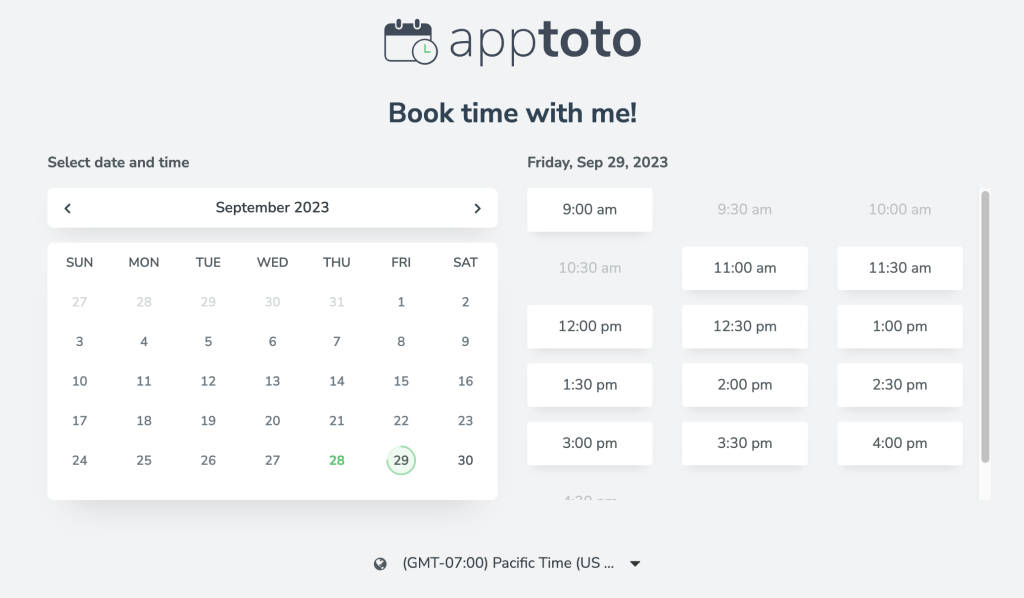
Many scheduling tools send reminders only for appointments booked through their own system. Phone bookings, walk-in follow-ups, and manually entered appointments get nothing.
Apptoto works differently. It integrates with Eyefinity and other practice management systems, so every appointment receives automated reminders, regardless of how it was booked. Both a phone booking and an online booking trigger appropriate reminder sequences. Nothing gets missed.
Track, measure, and keep improving
Automated reminders and online booking will make an immediate difference. To keep improving, you need data.
Know your baseline no-show rate
Track no-shows by appointment type, provider, day of week, and time of day. Most practices sense that no-shows are a problem, but don’t know their actual rate. You might find that comprehensive exams run at 10% while contact lens follow-ups hit 25%. That changes where you focus.
Even modest improvements pay off fast. Cutting your no-show rate from 20% to 10% among 100 weekly patients means 10 more patients kept their appointments. At $350 per visit (exam plus optical), that’s $3,500 per week, or over $180,000 per year in recovered revenue.
Adjust based on what you see
High no-show rate on contact lens follow-ups? Add an extra reminder touch. Monday mornings consistently bad? Overbook slightly or add a same-day call.
Rule-based messaging makes these adjustments simple. A quick frame pickup gets a single text. A new patient’s comprehensive exam gets the full three-touch sequence. You set the rules once; the system runs them.
Your schedule is your revenue. Protect it.
No-shows aren’t inevitable. The optometry practices that have fixed this use three things together: automated multi-channel reminders, online booking connected to their practice management system, and proactive recall outreach that re-engages patients before they lapse.
The common thread is automation that works with your existing tools. You shouldn’t need to abandon Eyefinity, switch practice management systems, or retrain your staff. The right solution plugs into what you already use and handles patient communication so your front desk can focus on patients, not phone calls.
U.S. businesses lose over $150 billion annually to no-shows and late arrivals. Your practice doesn’t have to contribute to that number.
Apptoto connects to Eyefinity to automate reminders, scheduling, and patient communication for optometry practices. Try it free for 14 days →