


To ask a client to reschedule by text, send the message as soon as you know the appointment must move. Name the original date and time, give a one-line reason only if it’s appropriate, and include a link or two open time slots so they can rebook in one tap. Keep it under 300 characters and send it during normal business hours.
Life is unpredictable. You might catch the flu, an employee’s car could break down on the way to work, or a pipe might burst in your office.
When you run an appointment-based business, unexpected events occasionally dampen your day and force you to reschedule appointments. The tricky part is alerting clients about rebooking as quickly as possible, before they show up excited and leave annoyed. Thankfully, text messages offer a quick, convenient way to reschedule appointments.
Explore how your businesses can use text messages to reschedule appointments, turning an unforeseen obstacle into an opportunity to strengthen customer relationships.
Want to skip ahead to the reschedule request templates? Click here.
Rescheduling Appointments via Text Messages
Text messages offer several key benefits over email and voice messages when you need to reschedule an appointment quickly. Here’s why:
- Quick Delivery & High Response Rates: Clients are more likely to see a text message before any other appointment notification. Text messages have a 98% open rate, and 90% are read within three minutes of being sent (OptiMonk, SMS Marketing Statistics, 2025). An email or voicemail can sit unread until the client is already in your parking lot.
- Client Satisfaction: Quickly alerting clients and offering convenient rescheduling options helps build trust, reducing no-shows and cancellations.
- Easy Rescheduling: If you must ask clients to reschedule, make it as easy as possible. You can add a link to your booking page in your text, allowing clients to rebook immediately rather than canceling for good.
- Saves your front desk hours: Not all your clients will rebook via text, and that’s okay! But any client who does helps reduce the time and administrative burden your team spends reaching out by phone or email.
An effective appointment messaging strategy can reduce no-shows and late arrivals by 40-70% on average. But if you can’t deliver messages consistently (hint: you’re doing it manually), you’re still at risk of losing valuable clients when you accidentally let a few appointment messages fall through the cracks.
What to Include in Appointment Reschedule Request Messages
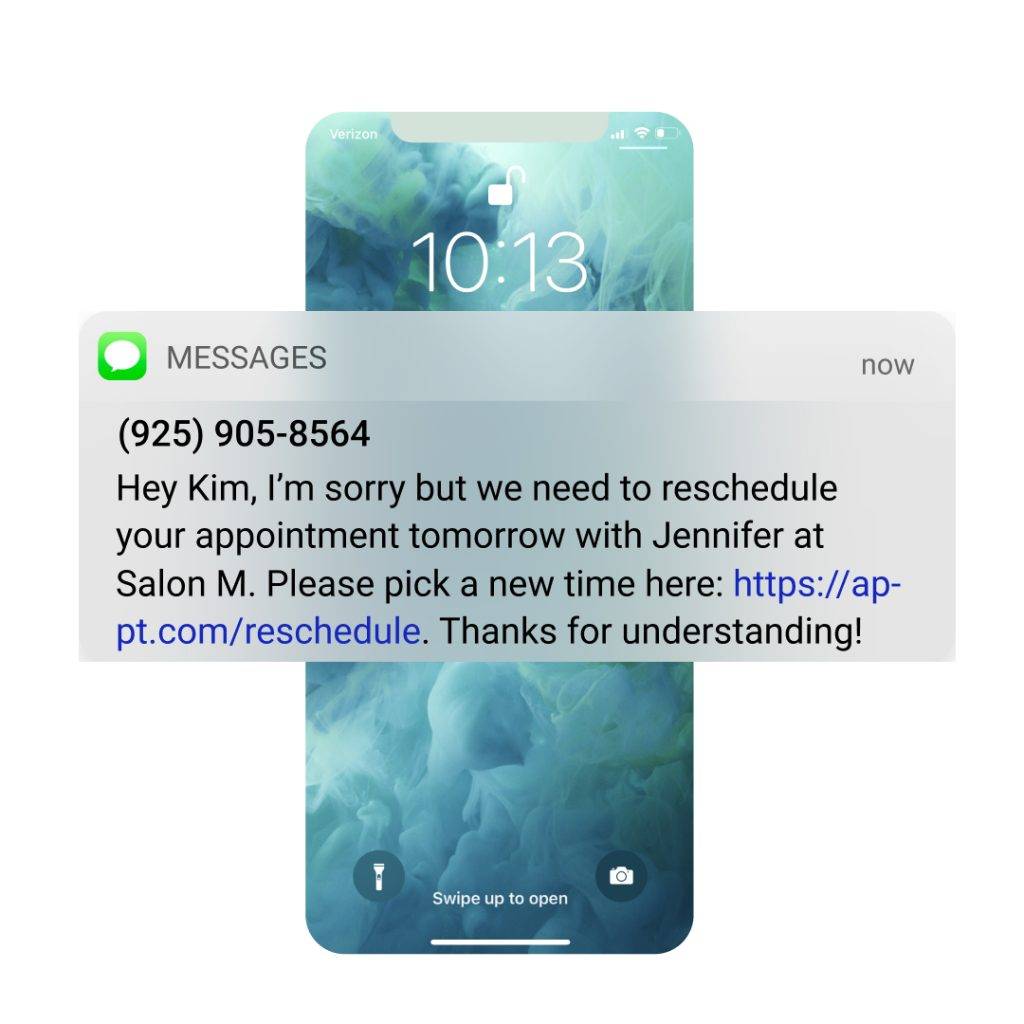
To create reschedule requests that your clients are most likely to respond to, consider utilizing the following:
Customized Messaging: Tailor messages to include the client’s name, specific appointment details, and rescheduling options. This personal touch enhances engagement and reduces misunderstandings.
Call to Action: Include a clear CTA in every message, such as “Reschedule now via our scheduling link: {{URL}},” to guide clients toward the next step.
Clarity: Ensure each message is clear and concise, including a quick explanation behind your need to reschedule (if appropriate – do not divulge any sensitive employee data) and rescheduling options (e.g., rebook with you at a later date, rebook with another provider).
An Incentive (Optional): Consider providing an incentive (such as a small discount or complimentary add-on service) if your reschedule request is being delivered on short notice or will cause a major inconvenience to your client. This helps build goodwill and may turn an otherwise frustrated customer into an advocate.
Best Practices for Rescheduling Appointments via Text Messages
It’s normal to feel anxious about asking clients to reschedule! To minimize disruptions and frustration for you and your clients, check out the list of best practices below.
- Timing: Send messages promptly. Send reminders and rescheduling options as soon as possible (within reasonable texting hours) to give clients enough time to adjust their schedules. Avoid sending reschedule requests at the last minute (<1 hour before an appointment) unless it’s essential.
- Consent: Before texting clients with any appointment-related messages, obtain client consent for SMS communication to comply with regulations like GDPR and TCPA.
- The FCC updated TCPA guidelines on October 1, 2026: a business can designate a reply keyword like STOP as the official opt-out method. Opt-outs must be honored within 10 business days (FCC fact sheet and draft order, Sept. 9, 2026; Latham & Watkins). For the full picture, see our guide to TCPA consent for appointment reminders.
- Follow-Up: Send a follow-up message to confirm your client’s new appointment, reduce confusion, and reinforce the schedule change. If you have appointment reminders set up, re-enroll the client in the appropriate sequence to ensure they are updated about their new appointments. Apptoto does this automatically when a client rebooks through the reschedule link.
- Templates: Instead of writing a new message every time, use a “reschedule request” text message template to save time! Personalize the templates, include CTAs, and check out the templates below for inspiration!
Appointment Reschedule Request Templates (Business-Initiated)
Every text message template below is ready to copy. Replace the [bracketed] fields and keep messages under 300 characters if possible.
Request to Reschedule Today
When to use: A provider is out today, and the client needs to rebook before they show up.
Hi {{Client Name}}. This is {{Name}} at {{Company}}. Unfortunately, we need to ask you to rebook your appointment today at {{Time}}. Please click here to pick a new time: {{Reschedule Link}}. Thanks for your understanding!
Request to Reschedule Any Time Template
When to use: The appointment is more than a day out, and the client can pick any new time.
Hi! This is {{Name}} at {{Company}}. I’m sorry, but we need to ask you to reschedule your upcoming appointment on {{Date}} at {{Time}}. Please click here to pick a new time: {{Reschedule Link}}
Request to Reschedule Next Week Template
When to use: You need to clear a specific day next week and want clients moved off it.
Hi! This is {{Name}} at {{Company}}. I’m sorry, but we need to ask you to reschedule next week’s appointment at {{Time}} on {{Date}}. Please click here to pick a new time: {{Reschedule Link}}.
Reschedule Request with Reason
When to use: A short, non-sensitive reason (weather, building issue, staffing) will help the client understand why their appointment is being moved.
{{Client Name}}. This is {{Name}} at {{Company}}. Due to {{Reason}}, we need to ask you to reschedule your appointment on {{Date}} at {{Time}}. Please click here to pick a new time: {{Reschedule Link}}.
Reschedule Request with Same-Day Options
When to use: The original provider is out, but another provider or a later slot is open today.
Hey {{Client Name}}, I’m sorry, but we need to reschedule your appointment today with {{Provider Name}} at {{Company}}. We have other openings available today: {{Reschedule Link}}. Or if you’d like to rebook with {{Provider Name}}, you can find their availability here {{Provider Booking Link}}.
Ask to Reschedule – No Reschedule Link
When to use: You don’t offer online booking and clients need to call to rebook.
Hi! This is {{Name}} at {{Company}}. I’m sorry, but we need to ask you to reschedule next week’s appointment at {{Time}} on {{Date}}. Please call our office directly at {{Phone Number}} to confirm a new appointment time.
Ask to Reschedule – With Incentive
When to use: The change is last-minute or a real inconvenience, and you want to keep the client’s goodwill.
Hey {{Client Name}}, I’m sorry, but we need to reschedule your upcoming appointment on {{Date}} with {{Name}} at {{Company}}. To say thank you for your flexibility, we want to offer you {{incentive}}. Book your new time here {{Reschedule Link}}, and we’ll see you soon!
Bonus: Ask to Reschedule – Brand Personality
When to use: Your brand is casual, and the client knows you well.
Hey {{Client’s Name}}, the universe has thrown us a curveball! We need to reschedule your appointment. Ready to join us on this rescheduling adventure? Find the perfect time for your next visit here: {{Reschedule Link}}!
Don’t hesitate to customize your reschedule requests using your brand voice. However, if you use levity or humor, make sure it’s appropriate and respectful (not all reschedule requests will be gleefully accepted by clients).
Appointment Cancellation Text Templates
Sometimes an appointment can’t be moved. It has to be canceled. These cancellation text message templates cover two directions: you canceling on the client and the client canceling on you. In both cases, the goal is to confirm what’s happening and make it easy for clients to rebook.
Business Cancels with Rebooking Link
When to use: You have to cancel and want the client to pick a new time on their own.
Hi {{Name}}, this is {{Your Name}} at {{Company}}. We’re sorry, but we need to cancel your appointment on {{Date}} at {{Time}}. You can pick a new time here: {{Booking Link}}. Thank you for understanding.
Emergency Closure
When to use: The office is closed unexpectedly, and you can’t offer a new time yet.
{{Name}}, {{Company}} is closed today due to {{reason}}. Your {{time}} appointment is cancelled. We will reach out as soon as we ar able to rebook. We’re sorry for the short notice.
Confirm Client Cancellation, Prompt Rebook
When to use: The client canceled, but you want to keep the door open to future appointment bookings.
Got it, {{Client Name}}. Your appointment on {{Date}} at {{Time}} is cancelled. Whenever you’re ready, you can book a new time here: {{Booking Link}}. We hope to see you soon.
Confirm Cancellation with Policy Reminder
When to use: The client canceled inside your notice window, and you want to remind them of the policy without charging a fee this time.
Hi {{Client Name}}, your {{Date}} appointment is cancelled. We ask for {{##}} hours’ notice to avoid a late fee, but we’ll waive it this time. Thanks for letting us know. Rebook anytime here: {{Booking Link}}.
If you don’t have a cancellation policy yet, or yours isn’t working, see our guide to writing an appointment cancellation policy.
When the Client Asks to Reschedule: Reply Templates
When a client texts “I need to reschedule,” a fast, friendly reply keeps the appointment on your calendar instead of losing it. Acknowledge the request, then give them a way to pick a new time. You don’t have to type this reply by hand: Apptoto’s auto-replies can send one of the templates below the moment a client’s text includes a word like “reschedule,” and mark the appointment as a reschedule request so your team sees it.
Acknowledge and Send Booking Link
When to use: You offer online booking and want the client to choose a new appointment time.
No problem, {{Client Name}}. Your {{Date}} appointment is cancelled. Pick a new time that works for you here: {{Booking Link}}.
Acknowledge and Offer Two Times
When to use: You want to steer your client into picking specific openings.
Thanks for the heads up, {{Client Name}}. We have {{Day}} at {{Time}} or {{Day}} at {{Time}} open. Reply with the one that works best and we’ll move you!
Acknowledge with Waitlist Offer
When to use: The client wants an earlier slot than you have available.
Got it, {{Client Name}}. The next opening is {{Date}} at {{Time}}. Want us to add you to the waitlist in case something earlier opens up? Reply YES and we’ll notify you if we can get you in sooner.
Missed Appointment Follow-Up Templates
A missed appointment doesn’t have to mean a lost client. A quick follow-up text often brings them back, and a firmer one sets expectations if it keeps happening.
First Missed Appointment
When to use: A client missed their appointment for the first time.
Hi {{Client Name}}, we missed you today at {{Time}}. We hope everything is okay. When you’re ready, you can rebook here: {{Booking Link}}.
Multiple Missed Appointments
When to use: A client has missed their appointment more than once, and you need to reference your policy.
Hi {{Client Name}}, you missed your appointment today at {{Time}}. Per our policy, missed appointments without {{##}} hours’ notice may incur a {{$X}} fee. To rebook, use this link: {{Booking Link}}.
For more on how to set and enforce a no-show policy, see our cancellation policy guide.
Choosing the Right Appointment Management Tool for Your Business
Handling rescheduling requests is just one component of what your appointment reminder software should be able to do. A robust appointment management system should help unify and simplify online scheduling, automated appointment messaging, payment collection, and beyond. Finding one that fits your needs and makes your life easier is essential. Let’s look at what to consider when picking an appointment management tool that works best for you.
- Identify Needs: Reflect on your business’s specific needs, then compare platforms to determine which best meet those requirements.
- Are you managing clients, internal meetings, or both? Does messaging differ for each?
- Do you need multi-user support? Multi-calendar?
- How much customization do you want for appointment messages (e.g., built-in, uneditable templates, or complete editability)
- Do you need text messages only? Are voice calls and emails required?
- Does your solution integrate with your calendaring solution, CRM, scheduling tool, etc.?
- Does your appointment management system include a scheduling tool?
- What additional features are helpful/important to you? Payment Collection? Two-Way Business Texting? Bulk Messaging Campaigns?
- Try Before You Buy: Utilize free trials or demos to explore features and ensure compatibility with your current setup.
- Security: Check for encryption and data protection measures to protect client privacy and business operations.
Apptoto Simplifies Automated Appointment Rescheduling
When it comes to rescheduling appointments with clients, efficiency is key. That’s where Apptoto steps in with a host of tools that make rescheduling stress-free.
Apptoto connects to the calendar you already use (Google, Outlook, Office 365, Salesforce, Clio, and more) and pulls every appointment into one view, along with each client’s contact details. From there, rescheduling works like this:
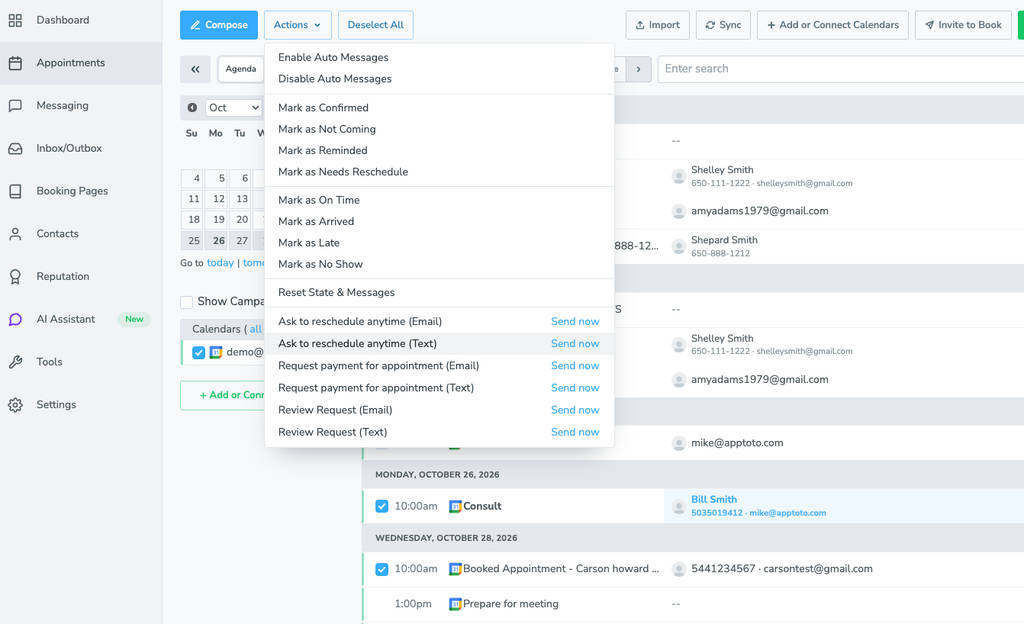
- Select one appointment, or check the box next to every appointment that needs to move.
- Click Actions and send an existing “Ask to reschedule” template or create your own. You can create a new custom template, or edit the wording of an existing one, under Messaging > Templates.
- Each client can get a personalized text or email with a link to pick a new time. Be sure to include a reschedule booking field such as {{ participant.reschedule_link }} which will add your booking link automatically.
You can set the reschedule window to any time in the future (see the full walkthrough).
Once a client picks a new time, Apptoto cancels the reminders queued for the old appointment and schedules the reminder sequence for the new one. The client gets an updated confirmation and reminders for the new date, and your team doesn’t touch it. It works the same whether the client rebooks through the link, calls the office, or emails you, because Apptoto reads the change from your calendar.
Frequently Asked Questions
Send a short text as soon as you know the appointment has to move. Include the client’s name, the original date and time, and a link or two open slots to rebook. A one-line reason is fine if it’s not sensitive. Keep it under 300 characters so it arrives as one message.
Apologize once, be specific about what’s changing, and make rebooking easy. “{{Name}}, I’m sorry, we need to move your {{Date}} {{Time}} appointment. Here’s a link to pick a new time: {{Booking Link}}.” is polite because it respects the client’s time and gives them control. Avoid over-explaining or asking them to call you back
As much as you can. Send the request as soon as you know, and try to give at least 24 hours (if possible) when the change is on your end. Reschedule requests sent less than an hour before an appointment should be reserved for true emergencies, and should offer something (a same-day alternative or a small incentive) to make up for the short notice.
Confirm the cancellation, say when it was, and give the client a way to rebook. For example: “Hi {{Name}}, your appointment on {{Date}} at {{Time}} is cancelled. You can book a new time here: {{Booking Link}}.” If you’re canceling on the client, add a short apology. If the client canceled, thank them for letting you know.
Wait a business day, then send one follow-up with the same booking link. If there’s still no reply, try a different channel, like a phone call or email. Don’t send more than two texts about the same reschedule; after that, it can feel like pressure. With automated reminders, you can schedule follow-ups so no one has to remember to send them.
Can Sending Rescheduling Requests be Stress-Free? Yes!
Whether you need to send a last-minute reschedule request or change a recurring appointment, Apptoto handles it all with ease. Apptoto lets your business focus on delivering exceptional service rather than managing appointment logistics. Say goodbye to rescheduling headaches and hello to a more efficient and streamlined appointment management process with Apptoto.
Ready to automate your rescheduling requests? Schedule a demo with our team of experts today to learn more, or sign up for a free 14-day trial.


